Garbage Warrior - Sustainable Housing


Empire Magazine ****
A documentary telling the epic story of maverick US architect Michael Reynolds.
Hippie architect Michael Reynolds has spent the past 35 years creating eco-friendly homes known as ‘Earthships’. Using beer cans and tyres to hold the structures together, he came up with a way of life that requires none of the traditional household fuels. Running foul of American planning mandates, he found his buildings threatened, but in the wake of the Boxing Day Tsunami and Hurricane Katrina, he has found recognition at last. Brit filmmaker Oliver Hodge’s documentary initially depicts its subject as a bit of an ass, but it gradually becomes obvious that Reynolds is a true humanitarian, offering a real alternative to modern living.
Documentarian Oliver Hodge depicts his subject as a true humanitarian.
The Times UK
An altogether more wholesome protagonist can be found in the cuddly form of Michael Reynolds, the star of Olvier Hodge’s inspiring documentary Garbage Warrior. For the past three decades this silver-tressed eco-hero has been transforming piles of glass bottles, beer cans and rubber tyres into wondrous houses in the New Mexican desert. Thanks to solar power, water stills and internal septic tanks, these ‘earth ships’ are ‘off-grid’ not reliant on any external electricity, gas, water and sewer systems.
As such, they arouse the suspicions of local government, and Reynolds is forced to shave off his beard and squeeze himself into a suit (‘You look like a homeless car salesman!’ his wife giggles) to plead his case at the state legislature. Having defied the onset of ecological Armageddon, he finds the filibustering obduracy of the American political machine a far more frustrating foe. Reynolds’s skills are far more appreciated in India’s Andaman Islands, where he helps locals to rebuild their devastated village after the Asian tsunami.
Time Out London
This interesting and timely documentary profiles unorthodox architect, eco-warrior and founder of Earthship Biotecture, Michael Reynolds. Since the late 1970s, the wild-haired 60-year-old has been setting up communities of increasing size in remote New Mexico locations based on his experimental, self-sufficient houses.
His 1972-built Thumb House pioneered his use of trash items, old glass and plastic, tin cans, earth-filled tyres and enclosed sewerage, water and heat collection systems. Since then, his radical and increasingly urgent ideas on sustainable living and his lopsided, idiosyncratic DIY dwellings like Mesopotamian kilns have brought him into dispute with US state and national planning and legal institutions.
Oliver Hodge provides an engaging examination of this tireless, free-speaking innovator, firstly on his building and land-acquisition projects with his wife, clients and supporters, through his battles to set up enabling legislation for experimental building and the recovery of his architecture licence and, more recently, constructing houses in the post-tsunami Andaman Islands. ‘I started all this thinking with quality of life in mind’, says Reynolds, ‘but we’re talking about survival now.’ Hodge doesn’t provide a critical nor comparative architectural thesis.
There are no references here to Reynolds’ inspiration, the visionary architect Buckminster Fuller, for instance, or the wider practitioners of ‘radical neo-global economists’. But his film does offer a fascinating glimpse of alternative living styles and point an accusing finger at the inactivity of our sleeping global masters.
Metro London
Garbage Warrior shows you how to make a difference
Imagine a home with no utility bills. That’s the beat-the-credit-crunch dream made real by charismatic eco-activist/architect Michael Reynolds, a wild-haired OAP cross between Rhys Ifans and a Furry Freak Brother, who’s been building entirely sustainable and strangely beautiful communities out of beer cans, mud and old tyres in New Mexico for the past 30 years.
Unsurprisingly, his belief that there’s ‘no progress without mistakes’ isn’t shared by the state planning department, which can’t see beyond the rule book and considers global warming ‘a myth’.
As it tracks Reynolds’s one-man battle to make sustainable housing sites legal, this funny, multi-layered doc is testament to the inspirational proof an individual can (literally) make a difference to the planet and a delightful, mind-expanding antidote to those housing-market blues.
Channel 4 Film UK
Documentary portrait of Michael Reynolds, an American architect who has spent years innovating sustainable housing techniques
Oliver Hodge, a former effects, props and miniatures man on Star Wars Episode I: The Phantom Menace and Troy, makes a change of direction with this documentary about visionary architect Michael Reynolds.
It’s a no-nonsense portrait of the man who has spent 35 years experimenting with “radically sustainable living” and now finds himself in a David and Goliath battle with the US legislative process. Reynolds lives and works in New Mexico, a place where the US government committed thousands of acres to unpredictable irradiation through A-bomb testing: yet in 2008 the powers that be are unwilling to commit a couple of hundred acres to experimental housing. This irony sits at the heart of the film.
There’s no denying Reynolds is a leftfield kinda chap. He thinks way outside the box, but his thinking is based on very simple, basic logic: architecture should be about people and society. And people and society won’t be around for much longer if we keep living so wastefully.
It’s the besuited, intractable middle-aged white men who are the cranks here, with their head-in-the-sand attitude. (Sounding like a Rory Brenner caricature, one Republican Senator says, “You can’t prove global warming with science… it’s a myth”). Yet these people represent the mainstream, they represent power and what they say goes, leaving Reynolds with a serious uphill struggle.
“Hard-packing dirt into old tyres created a building material with astonishing thermal capacities ”
As well as being about harsh ecological arguments, Garbage Warrior is also a portrait of an energetic and inspiring figure. Reynolds started on his path when, during his training in the late 1960s, he realised the irrelevance of much of what he was learning.
Shortly afterwards he started experimenting, using discarded beer cans as bricks. Then he moved on to a system involving hard-packing dirt into old tyres to create a building material with astonishing thermal capacities. The buildings constructed using tyres, dubbed “Earthships”, have no heating or cooling systems, yet are comfortable in a desert where the temperatures soar in the summer and can get down to -35C in the winter. When Reynolds had his first success, he reminisces, “It was like, Jesus Christ man, I’m free, absolutely free.”
Since then, his techniques have evolved with each subsequent house, forming communities of people living “off the grid” – with no piped-in utilities, just “wind, solar, greenhouse, garbage building”. His housing involves “taking every aspect of your life and putting it in your own hands.” That’s something the government isn’t too keen on, demanding that sub-lots have utilities, even when they don’t need them. This conflict stopped his practice for a few years, and even when he resumed, it killed off the living research and development process that happened with each new project.
“A fascinating, stirring eco-documentary ”
Garbage Warrior shows two attempts to put his draft bill through the New Mexico senate. Those head-in-the-sand besuited men are a frustrating lot, but Hodge also follows Reynolds and some of his acolytes to the Andaman Islands. There, the techniques are embraced by the victims of the tsunami, people who don’t quibble about reclaiming materials but simply understand the logic and need.
The dynamism of Reynolds and his team working with the Andaman Islands is contrasted with shots of snoozing senators. The implication is clear – The Man is sleeping while humanity becomes increasingly imperilled by our illogical, wilful energy inefficiency.
Another fascinating, stirring eco-documentary.
Time Out New York
Waste not, want not. Director Oliver Hodge kicks off Sundance’s environmental month with the inspiring Garbage Warrior.
They say one man’s trash is another man’s treasure, but if Mike Reynolds has his way, our collective trash might turn out to be something significantly more valuable‚ the means for our environmental salvation. At least that’s part of the argument presented in Oliver Hodge’s Garbage Warrior, the film that kicks off the second season of ‘The Green,’ the Sundance Channels Tuesday prime-time programming block devoted to environmental issues and solutions.
The title of the movie refers to Reynolds himself, a long-haired, effusive architect based in Taos, NM, who builds off-the-grid, self-sustaining homes with refuse such as used car tires, discarded bottles and empty beer cans. But his work is not just about recycling garbage: Utilizing everything from giant wind turbines to solar panels, the homes, dubbed ‘Earthships’ are not only environmentally conscious, but also aesthetically dramatic, as Reynolds constantly tries out new plans and materials. Calling the current climate crisis a potential ‘end of days’ scenario, Reynolds considers his work a race against time. ‘someone who realizes the extent of the coming disaster, and is trying to do something about it’, says director Hodge. ‘He realizes that not everyone can survive, and he’s trying to do the best he can. At the same time, this gets him into a lot of trouble‚ which is another reason why I felt his story needed to be told.
The trouble Hodge is speaking of is a reference to an important episode in the film‚ and, obviously, in Reynolds’ career‚ when bureaucratic pencil pushers intervened and took away his architect’s and contractor’s licenses, precisely because these homes did not connect to the very centralized and powerful utilities that he had purposely avoided. The authoritarian meddling brings out Reynolds’s politically combative side, as he goes to the state legislature to lobby for a sustainable test-site law. The sight of the scruffy architect wandering the halls of power trying to get straitlaced politicians in line with his vision has an endearing, quixotic quality to it, but with an undercurrent of tragedy, given the urgency of the situation.
Somewhat ironically, Reynolds’ visionary designs and building methods have found more takers and political will abroad: Hodge shows how the architect and his team of volunteer builders were called to help with new building projects on a tsunami-ravaged island in 2005. Indeed, the U.K. filmmaker was first introduced to Reynolds’ work when the builder came to Hodge’s hometown of Brighton to help build Britain’s first Earthship. Hodge shot the project as a potential short TV piece. The more he interviewed Reynolds and thought about it, however, the more he realized that he wanted to spend further time with Reynolds and see where his story went.
Hodge turned out to be the ideal filmmaker to portray the architect and his work: Trained as a designer, he has also served as a special-effects and prop-department head on numerous big-budget films, including Star Wars Episode I: The Phantom Menace and Charlie and the Chocolate Factory. ‘When I saw Mike working with his crew, it reminded me a bit of what I do in the film industry’, Hodge says. ‘I draw a lot of designs but I also build a lot of stuff with my crew.’ Perhaps more importantly, the director’s background allows the film to provide a compelling, at times even awe-inspiring portrait of Reynolds’ revolutionary designs. ‘It’s not easy to shoot these buildings and spaces,’ he says. Especially when, as a documentarian, you’re running all over the place, trying to get the shots you need and also essentially writing the movie on the fly.’ He concedes, however, that many of the most affecting portraits of Reynolds’ designs wound up as bonus features on the DVD of the film, which is available at www.garbagewarrior.com.
Perhaps one of the primary reasons for the film’s success is that the director felt it important to not preach to the choir: ‘I wanted this to go out to as wide an audience as possible to get the notion of sustainable living to an audience that wasn’t necessarily involved in green issues.’ He notes that the film, which has been released in numerous countries, has already helped Reynolds win new commissions, including a seven-story building in Norway proving that Garbage Warrior succeeds as more than just a movie.
New York Times
Michael Reynolds, the rebel architect who is the subject of Oliver Hodge’s documentary, ‘ARBAGE WARRIOR’ could be described as the ultimate recycler. Since deciding early in his career that his training was worthless, he and a small band of followers have devoted their energy to creating structures he calls environmental earthships: housing made of discarded automobile tires, beer cans, plastic water bottles and other landfill materials mixed with dirt. The shapeless structures have no electrical lines or sewer pipes and make maximum use of light, wind and rainwater.
‘Garbage Warrior’ belongs to the David and Goliath school of documentary filmmaking with its true story of a scrappy little guy taking on the big, bad establishment. Mr. Reynolds’ constructions, many of them in the New Mexico desert around Taos, inevitably violate local zoning and housing regulations. The movie focuses on his 1997 courtroom battle after the authorities tried to shut down an earthship community. A charismatic, shaggy-haired renegade with a warm sense of humor, Mr. Reynolds makes agreeable company.
The Guardian
Michael Reynolds, radical architect
What is your biggest guilty green secret? I like bacon. I eat it whenever I can get it. But obviously any kind of meat leans on the side of not being too perfect.
Do you know your carbon footprint? No, but it’s got to be pretty reasonable. I live in one of my “earthships” [a home made from recycled materials and powered by renewable energy] in New Mexico. They are all about living as close to being as carbon neutral as possible. For example, in the future we’re going to be putting a household plant for making biodiesel into every earthship, so they’ll not only produce their own hot water and power and dispose of their own sewage, but they’ll also produce their own fuel.
What was the last green thing you did? I have to say this whole green thing is a little bit hard for me. In the 60s every-one talked about love and peace but no one really knew what it meant. Now they talk about green, so that if you’ve put up a shelf made out of recycled wood, you’re green. Green for me is just too light a word for what we need. We need something much more radical.
What wakes you up in the night? Everything I’m doing is pretty unorthodox and unconventional. I’m always out on a limb financially and I guess that is sometimes hard.
What skill do you have for a post-oil world? I’m already living in one. They should be teaching this stuff to children along with writing and arithmetic. Most people in their 40s and 50s just don’t seem to accept that this is happening, but we need everyone to move radically in a different direction.
What would you save, apart from your family and friends, come the floods? Well, I see those floods coming now. I am trying to get as many people as possible into the lifeboats.
Screen and Words Magazine
Once upon a time, in the enchanted land of New Mexico, there lived a grey wise man in a beautiful palace made from colourful bottles, cans and car tyres. He and his wife were very happy. They never had to go to the store, they didn’t have to pay for their electricity or their water. And they were never bored because they had good friends living near them, in more castles and igloos and huts, all made from the precious things the rest of the land considered garbage. The wise man had designed all the castles and palaces and igloos and huts himself, sometimes with a little help from his friends. His love for these habitats and his knowledge of thermal mass kept the houses warm even in the dead of cruel winters. There was fresh food growing in internal green houses, and the palaces were filled with bright, natural light. And the grey wise man saw it was good.
Then, he got hit with a massive law suit. The palaces didn’t adhere to standard building procedures. Michael Reynolds, architect and escapee from a Baptist background, has been experimenting around the concept of sustainable living in the New Mexico desert for almost four decades. He has created living conditions easy on the earth and on the eye. His buildings are incredibly awesome, oriental starships richly ornamented with an assortment of what is commonly considered rubbish. Which is exactly why the State of New Mexico decided none of the important, potentially life-saving innovation going on in the middle of nowhere should be put to a stop immediately.
Admittedly, the compound Mike and his crew have assembled does not have clearly defined boundaries between properties, there aren’t even proper roads in place. Instead there are jumbled prototypes of houses that would allow entire families to experience a highly independent and ecologically über-correct lifestyle. Children born in the compound believe that water comes from the roof and turns drinkable somewhere on the way from there to the tab. They know how fruit grows, because it grows in the living room. According to legislation, this is wrong.
Thus Reynolds purchases a suit, ties back his hair, and descends into the labyrinth of legislative losers in order to save his vision.
Garbage Warrior serves two purposes. Firstly, it will quite plainly inform you that the way you are living is not necessarily the way you have to live. Or should live. There are alternatives. They are well developed, and not all that hard to put into action. So instead of being ripped off paying for services that are destroying the environment a little more every day, you could maybe take a slice of the Reynold philosophy of active and creative recycling, and help turn things for the better. Secondly, it shows that brilliant ideas are not necessarily supported by those in power. In principle, to any rational human being, fostering and expanding Reynolds’s project is a no brainer. It works, looks good and does good. However, it does break all the rules held in place by countless committees for what seems like eternity. People who should be showering Mike–the–Hero with funds and praise not only fail to give a toss, they also do their utmost to put a stop to his exploits. For no reason other than refusing to consider the long-term application of their method and his method for more than five seconds.
Oliver Hodge’s documentary is an eye opener in all respects. Things can be done, they take time but we see them being done, by normal (sort of normal) individuals who realise that this idea makes perfect sense. Garbage Warrior teaches that if this kind of things makes sense to you, you should do something yourself, since, chances are, authorities are in no rush to beat you to it. So, give an assortment of fingers to the established way of life (even if it means planting a single tomato plant in a window box, just start somewhere) and go eco. Don’t wait for a big disaster to wise up, Garbage Warrior is inspiration enough
Eye For Film ****
“To build a house you need bricks”, Peter Sellers’ idiot savant character remarked in the 1979 classic Being There. He’d obviously never met Michael Reynolds, eco-pioneer and hero of Oliver Hodge’s captivating documentary.
Ever since graduating as an architect, Reynolds has delighted in taking an unconventional, experimental approach to his craft using materials like beer cans and used car tyres to create solar-powered, water and sewage-recycling homes that cost virtually nothing to run and leave a dormouse-sized carbon footprint.
Much of his effort has gone into creating a community of earthship houses, bizarrely-shaped structures which used the heat trapped in the soil-filled tyres and beer cans as insulation that withstood even the sub-zero temperatures of the high country near Taos, New Mexico.
Like-minded folk journeyed there to live in the first houses and help him build more, while sympathetic local officials turned a blind eye to his disregard for conventional methods and the state’s building regulations . But in the 90s a new broom at the planning office noticed that none of the buildings were connected to the centralised utilities and therefore in breach of just about every rule in the book.
Ignoring Reynolds’ argument that that was the whole point, they prohibited him from building any more Earthships and took away his architect’s licence. Some people would have thrown in the trowel and gone back to designing shopping malls or gherkin-shaped office blocks. But Reynolds, a beguiling mix of hippy idealism and stubborn bloody-mindedness, is determined to carry on.
He drafts a bill allowing his community to be designated a ‘sustainable building test site’ and submits it to the state legislature. But this proves to be a tortuous, frustrating process where, despite gaining some allies at City Hall, the bill runs out of time due to procedural delaying tactics.
It seems his vision has no future but out of the blue comes a request for help from a community in the Andaman and Nicobar Islands, recently devastated by the Asian Tsunami. They don’t care about bureaucracy or the struggle between big business and the individual they just want shelter, and quick.
Reynolds takes his veteran crew to India and they meet a community receptive to his ideas and willing to work 24/7 to make them reality. This section provides some of the film’s most moving moments, as people devastated by a horror worse than any we can imagine talk of losing entire families, but devote all their energy, skill and resourcefulness to building new homes from little more than mud and empty water bottles.
The community takes Reynolds to their hearts and back in America, Hurricane Katrina has shown that the power of nature can bring a modern city to its knees. All of a sudden, his long-held views on global warming and the need to think of alternatives before it’s too late appear prescient and necessary. He finds himself in demand for rebuilding projects much closer to home and decides to give his bill another try…
It’s a cracking tale, and Hodge has a compelling character as its protagonist. Reynolds is a shock-haired ball of energy, overflowing with ideas and opinions about the future of the earth, the relationship between architecture and big business and the nature of America itself. As he points out, the country was founded on the principle of making your own home, and your own destiny, with whatever materials you could find and harness; he sees his methods as an extension of that.
He and his community are definitely from the alternative end of the spectrum, but they’re most definitely not the fey, unworldly layabouts of popular stereotype. The sheer amount of hard graft (often in hostile conditions) they put into trying to make their way of life work is remarkable, and inspiring. When Reynolds is forced to tie back his hair, put on a suit and tackle a bureaucratic machine whose default setting seems to be inertia, you sense how much of an effort it is and you’re willing him to succeed.
Eschewing Michael Moore-esque gimmicks or editorialising (there isn’t even a voiceover) Hodge is confident and clever enough to let the story tell itself, letting a few key images (the island children playing with Reynolds’ workers in the ruins of their village; state senators falling asleep as the first bill is filibustered to extinction) make his points.
It may not have you heading for the New Forest with a crate full of empties, but you will leave the cinema thankful that there are people like Michael Reynolds about willing to challenge any status quo and put every ounce of their energy into working for what they believe in.
The Telegraph UK
Frank Lloyd Wright meets Uncle Bulgaria
The subject of Oliver Hodge’s documentary is an architect whose creations could be described, not unfairly, as rubbish. For 35 years, Michael Reynolds – part Frank Lloyd Wright, part Uncle Bulgaria – has been employing discarded cans, bottles and tyres to produce ‘radically sustainable living’. Naturally, those favouring a more conventional architecture are keen to throw his designs back on the scrapheap.
Throughout this sometimes fuzzy-headed but good-spirited portrait of a single-minded visionary, Reynolds pitches his work not as a necessary eco-sacrifice, but as a form of liberation from mortgage payments and heating bills. This, you suspect, might be a very Californian idea of freedom, spawned of the fact homes in the New Mexico desert probably don’t need all that much heating – it remains to be seen how the Reynolds model might be adopted by viewers in Droylsden or Goole.
There’s too much footage of committee meetings to illustrate how resistant the system is to change. The film is happier following Reynolds to the tsunami-hit Andaman Islands, where his team can put their ideas into practice, and when the documentary’s arguments in favour of a new design for living redouble in strength.
Evening Standard London ****
It’s hard at first to understand what British documentary-maker Oliver Hodge sees in eco-architect Michael Reynolds. In various snapshots we find the man draped over motorbikes, crinkly hair blowing in the breeze. He looks like Robert Plant’s demented older brother. He clearly thinks he’s sex on wheels. Once Hodge gets into the nitty-gritty of Reynolds’ DIY projects, however, the film becomes mesmerising.
Reynolds spent years in New Mexico using old tyres, beer cans and rainwater to try to create offthe-grid, solar-powered homes. He often got things wrong, leading to leaks and explosions. Over a period of three years we watch Reynolds’ mission to create test sites where architects can try out new ideas safely being thwarted by bureaucrats. He’s been sued on numerous occasions and in 1997 lost his architect’s licence.
It is unclear whether Reynolds’ earthships would work in countries like England (what if the sun doesn’t shine?) but they look remarkably impressive here, and would probably come in handy in Burma and China right now.
Hodge, who has never made a film before, obviously identifies with his hero’s can-do attitude. He sticks close to the old hippy and as a result takes us all on a wild ride.
Mid Devon Star
American outsider architect Michael Reynolds creates beautiful ramshackle homes in the New Mexico desert out of discarded beer cans, reclaimed wood, old tyres and clay, the physical manifestations of his life’s passion for sustainable living. But Reynolds is not so much an architect as a one-man eco-movement, a visionary whose ideas will either help us save the planet or just land him in more trouble with the local authorities. Shot over three years in the US, Mexico and India, this is an extraordinary, intimate portrait of a man possessed by his dream of changing the world.
Financial Times
From despair to hope, and that against seemingly insurmountable odds, in Garbage Warrior . Mike Reynolds is a man of remarkable vision and admirable tenacity. Since the early 1970s, this most environmentally conscious of architects has been exploring the possibilities of green building in a remote corner of New Mexico. There, he and his followers have built houses from sustainable materials, using recycled tin cans, plastic bottles and, in one of Reynolds’s most brilliant touches, dirt-filled car tyres, so creating homes requiring little or no heating even through New Mexico’s bitterly cold winters. There is no drama without conflict, of course, and Oliver Hodge’s engaging film follows Reynolds as he struggles to overcome political opposition that threatens the future of his oddly beautiful houses and communities.
Institue of Contemporary Arts
American outsider architect Michael Reynolds creates beautiful ramshackle homes in the New Mexico desert out of discarded beer cans, reclaimed wood, old tyres and clay, the physical manifestations of his life’s passion for sustainable living. But Reynolds is not so much an architect as a one-man eco-movement, a visionary whose ideas will either help us save the planet or just land him in more trouble with the local authorities. Shot over three years in the US, Mexico and India, this is an extraordinary, intimate portrait of a man possessed by his dream of changing the world.
Brit Films Catalogue
Shot over three years in the USA, India and Mexico, Garbage Warrior is a feature length documentary film telling the epic story of maverick architect Michael Reynolds, his crew of renegade house builders from New Mexico, and their fight to introduce radically different ways of living. A snapshot of contemporary geo-politics and an inspirational tale of triumph over bureaucracy, Garbage Warrior is above all an intimate portrait of an extraordinary individual and his dream of changing the world.
The Independent UK
A documentary portrait of maverick architect Michael Reynolds who, with his trusty crew of house builders, has pioneered an approach to “radically sustainable living” on the outskirts of Taos, New Mexico. Conventional architecture, he says, “had nothing to do with the planet, barely had anything to do with people”, so he set out to build houses from tin cans, plastic bottles and used tyres. Some of them are still standing.
Inevitably, he ran into trouble with the local planning authorities, and for a while had his building licences confiscated, but this is plainly not a man to be cowed by bureaucracy. Oliver Hodge’s film is properly affectionate as well as being instructive, and even reaches towards the heroic in its chronicle of Reynolds’ aid work following the Asian tsunami and Hurricane Katrina. Part-Womble, part-eco visionary, the man is a one-off, and wholly cherishable.
The London Paper
With ecological issues and recycling at the forefront of the political agenda, this documentary celebrates a maverick architect who has been challenging the system for more than 30 years in his corner of New Mexico. Garbage Warrior pays tribute to Michael Reynolds, who creates accommodation from discarded materials included plastic bottles and beer cans. Battling against bureaucratic red tape and zoning laws, Reynolds continues to promote his environmentally friendly structures as the housing of the future, proving his point when he travels to the Andaman Islands to assist the victims of the tsunami to rebuild their shattered communities.
Reviews on Cinema Clock
For a first feature documentary, Oliver Hodge’s Garbage Warrior is remarkably assured and accomplished. With ample wit, humour and insight, he reveals the extraordinary life of the brilliant visionary architect, Mike Reynolds. For decades, Reynolds has been designing self-sustaining houses, which generate their own heat, cooling, electricity, water supply, and even food. Made of recycled materials including used beer cans, pop bottles and tires filled with earth, they are often rustically and sensually beautiful. They can be built in the most inhospitable regions and can withstand earthquakes. As Reynolds mentions in the film, these evolutionary and revolutionary homes can liberate people from societal dependence. Not surprisingly, he’s run into considerable obstacles from those in power. While tracing Reynolds’ battles with authority, Hodge builds a nerve-wrenching sense of suspense with enough unexpected twists and turns to be worthy of a Hollywood thriller. After seeing this film, you will never be able to look at your home, society or the world in quite the same way again. Not to be missed.
Total Film
‘It’s a direction for humanity,’ says architect Mike Reynolds as he recycles bottles, beer cans and tyres into self-sustainable homes. Thankfully short on eco guilt trips, Oliver Hodge’s doc follows this maverick as he battles the red tape that entangles his regulation-flouting designs in New Mexico before decamping to tsunami-ravaged India, where his innovative shelters can save lives. Despite being more structurally flawed than one of Reynolds’ Earthships and scarcely delivering on its promise of drama, this is a breezy watch. Reynolds comes off as a cuddly, eccentric, if slightly apocalyptic, Womble. Blustering bureaucrats ‘one Republican dismisses Global Warming as a myth’ make it easy to cheer him on. Inspiring rather than inspired, maybe, but its charms are hard to resist.
The Guardian
A low-budget documentary on “off-grid” pioneer Michael Reynolds, a scruffy, hippie-ish architect with irrepressible energy and an uninhibited mouth. For the past 35 years, in the New Mexico desert, Reynolds has been building “earthships” – houses made of “junk”, such as bottles and tyres, which generate their own heat, power and water. They are eco-friendly, cheap to live in, but not, it happens, within US building regulations. So, over several months, we follow Reynolds’s frustrating campaign to persuade the Senate suits to permit him to save the planet, with a belated detour to the tsunami-struck Andaman Islands to see his low-tech know-how in action. The focus is a little narrow, but Reynolds is very good company, and his ideas deserve wider exposure.
VUE Weekly
Solutions aren’t in short supply in Oliver Hodge’s Garbage Warrior, a jewel of a documentary, three years in the making, not just because it’s beyond hopeful to the point of down-right enervating, but because of its subject Mike Reynolds, an architect of self-sustainable housing. Reynolds looks like a long-retired 60s rocker but, like his crew, he’s a driven, passionate, fascinatingly down-to-earth soul. Convinced of humanity’s slow self-destruction, Reynolds believes we can do better than survive, perhaps even enhance the planet. In New Mexico, once known for its annihilating nuclear test, Reynolds is a creator, building dozens of homes (some called earthships) out of recyclables and reusables: dirt-packed tires (for heating and insulation), beercans or bottles (as bricks), and glass (for solar heating). The toughest battle for this feisty, fulminating greybeard is wading through the garbage of state bureaucracy in order to fight subdivision laws and pass a bill that approves of his trial-and-error test buildings. North America’s tottering, top-down political structure (‘American politics is a fucking dinosaur that’s not gonna make it’) only makes Reynold’s and his crew’s grassroots, cooperative work with the people of the Andamans all the more inspirational. In 2005, they went to the tsunami-ravaged islands to build simple, self-sustainable housing with the people there, and what they accomplish is a model of organic, independent, off-the-grid living. Garbage Warrior is a brilliantly constructed film about a larger-than-life, passionate visionary who shows that simple change isn’t just urgent, but blindly obvious and well within reach. All we have to do is take a second-hand look at what we’re dumping out our back doors
Ecopreneurist Garbage Warrior! Let Me Count the Ways Thou Art a True Pioneer, by Olga Orda
Wow. Try convincing the zoning regulators to give the OK for more density let alone allow beer cans, car tires and water bottles be your tools of choice to produce thermal mass and energy-independent housing.
Not a chance you could pull it off unless you’re renegade architect Michael Reynolds, Garbarge Warrior.
Apparently, for 30 years New Mexico-based Reynolds and his green disciples have devoted their time to advancing the art of Earthship Biotecture by building self-sufficient, off-the-grid communities where design and function converge in eco-harmony.
No surprise that these experimental structures that defy state standards create conflict between Reynolds and the authorities, who are backed by big business.
Set on taking action on near Neanderthal zoning legislation, Reynolds lobbies for the right to create a sustainable living test site.
In a cruel and ironic twist, Mother Nature leaves no room for wishy-washy politicians as she devastates communities by tsunamis and hurricanes.
Shot over three years and in four countries, Garbage Warrior is a timely portrait of a determined visionary, eco-entrepreneur and a hero of the 21st century.
Huck Magazine
According to accepted wisdom, the greenest thing we can do with our old drinks cans is put them in the recycling bin. Not so, says Mike Reynolds, eco warrior and star of Oliver Hodge’s debut documentary, Garbage Warrior, which opens at London’s ICA this Friday. We should be making houses out of them.
Since graduating from Architecture School in 1968, Mike Reynolds has been chasing one ideal. His aim ‘to make a blueprint for eco friendly homes, built cheaply from readily available materials, which can exist ‘off grid’ producing their own electricity, collecting their own water, and even allowing residents to grow their own food. This is a mammoth, but vital task. In the UK for example, around half our carbon dioxide emissions are a result of domestic uses.
And what material’s most readily available in the West? Rubbish, of course. Some of Mike’s houses are built from tyres filled with earth, while others from cans or bottles encased in mud walls. As well as being cheap and green, these building techniques have added advantages. They are extremely thermally efficient, keeping his structures warm in winter and cool in summer, and often weirdly beautiful.
His first forays into sustainable building were twenty-five years ago, in Taos, New Mexico. For a time, sympathetic local councillors allowed him to bypass planning regulations. As a result, a community of similar eco houses, or earthships were built in the area. Regime change at the planning department sucked the wind from his sails. The houses would have to conform to the letter of the conservative local planning laws, or else they were coming down.
Clean shaven and wild grey hair tied back, Mike dons a suit and sets about challenging the decision in the offices of the powers that be. He proposes a test site, where the usual planning laws are laxed, in which he can perfect his building techniques and so bring them to the world. A pretty reasonable request, you might think, especially given the American authorities tested the nuclear bomb in New Mexico. But, politics being politics, vested interests seem to come before environmental protection every time.
Previously a model maker for films such as Tomb Raider and the Phantom Menace, this is Oliver Hodge’s first time as director. Garbage Warrior was a labour of love, funded from his own savings until a sponsor was found late into production. An environmentalist himself, Oliver had long wanted to make a film which discussed big issues like climate change, but needed a narrative through which to do so. Meeting Mike in May 2003 he realised he had his story.
Garbage Warrior is a fascinating insight into the world of a man with a vision, and his interactions with a frustratingly stagnant political system. Following this remarkable tale makes for compelling and necessary viewing.
Aukland Movie Review ****
A fascinating documentary about an equally fascinating man, Garbage Warrior is by turns funny, heart-breaking and genuinely inspirational.
What’s it all about? Directed by Oliver Hodges and filmed over three years, Garbage Warrior tells the story of 60-something maverick US architect Michael Reynolds and his fight to introduce radically sustainable housing. The first part of the film shows Michael and his loyal team of house-builders (many of whom were previously down-and-outs) building completely self-sustainable houses in the New Mexico desert out of the things society throws away (e.g. using sand-packed tyres and strapped-together beercans as bricks).
The film then details Reynolds’ complex legal battles (he was stripped of his architect’s license because of safety issues) and his fight to introduce a bill that will permit the exploration of environmentally sustainable housing techniques. However, when the 2004 tsunami strikes, Michael and his team are invited to the Andaman Islands and asked to help build sustainable dwellings for survivors.
The Good When we first meet Reynolds, it’s tempting to dismiss him as just another tree-hugging hippy type, particularly when he’s showing some of his earlier houses and admitting to things that used to go wrong (problems with sewage systems, tenants filing lawsuits, someone complaining because their typewriter melted, etc.). However, Reynolds soon wins you over as his genius becomes increasingly evident; plus, it’s both telling and touching that his fellow builders look up to him as a sort of much-loved father figure.
Like all the best documentaries, Oliver Hodge’s film is highly informative and genuinely inspirational. It will also make you laugh, cry and seethe with rage about the current Bush administration. Reynolds is told not to mention global warming if he wants to stand a chance of getting his ground-breaking bill through.
The Great The initial sequence with Reynolds anxiously watching the political process is incredibly tense and ultimately heart-breaking, there’s a real air of Mr Smith Goes to Washington about the filibustering scene.
Worth seeing? Garbage Warrior is a terrific documentary that is well worth seeking out. Highly recommended.
The British Documentary Website
American outsider architect Michael Reynolds creates beautiful ramshackle homes in the New Mexico desert out of discarded beer cans, reclaimed wood, old tyres and clay, the physical manifestations of his life’s passion for sustainable living. But Reynolds is not so much an architect as a one-man eco-movement, a visionary whose ideas will either help us save the planet or just land him in more trouble with the local authorities. Shot over three years in the US, Mexico and India, this is an extraordinary, intimate portrait of a man possessed by his dream of changing the world.
Obviously CA
Are you fed up with hearing about global warming and how it’s going to destroy our planet? Are you beginning to feel like maybe there isn’t anything you can do about it? Garbage Warrior may just be the documentary that shows you that there’s some hope.
Michael Reynolds is an architectural entrepreneur who creates completely sustainable off-the-grid communities out of recycled materials, such as beer cans and glass bottles. Reynolds began his one-man crusade against waste because he wanted to create a future that is healthy for future generations. Garbage Warrior begins by examining his creations and then shows us how his recycled communities were built.
However, when the government receives word of his project, his communities are shut down, as subdivisions must rely on the area’s system of water and heating to classify as a community. Reynolds says that he ‘lost the right to dream and experiment’ with the closures. However, instead of remaining devastated and beaten, Reynolds decides to take action instead. He becomes an advocate for his cause, taking his case to the state legislature looking for change.
In Garbage Warrior, we get to see the U.S. legislation process in action, including all the minor changes, hold-ups and bureaucracy that come into play with any new bill. Reynolds’ mission highlights the sheer amount of human energy that is wasted in dealing with small changes in proposed bills is absurd. He takes his case to as many senators as he can, trying to make sure that his bill passes, only to be filibustered in 2005. His attempts keep on failing, but Reynolds’ perseverance pays off, as in 2007 a test site for his project is approved.
Shifting away from the bureaucratic battle, Garbage Warrior takes us back to 2005 and India to acknowledge the work Reynolds and his team did in the wake of the tsunami. They build low-tech shelters to house the victims using local materials that are self-sustainable and inspired by the American communities Reynolds has developed. However, instead of stopping the flow of design, and the government in India and the beneficiaries of the project embrace the concept. Reynolds points out, that it took days, not years, to achieve off-the-grid communities in the developing areas, whereas it will take years to implement in the developed world. Reynolds believes it will take a massive natural disaster in order to shift the thinking on the idea of sustainable communities.
The film highlights Reynolds’ lifestyle choices, and introduces the audience to a wide range of characters, including his family, his business partners, as well as many government officials. While this documentary is slow to get started at the beginning, it picks up steam as Reynolds’ struggle unfolds. Garbage Warrior does a good job of connecting local and global issues by highlighting the work Reynolds’ team does with tsunami relief. It provides a concrete example of someone taking action to better the world despite facing governmental adversity and struggle.
Garbage Warrior: a must-see for any innovator out there.
Variety
In single-minded pursuit of “a method of living that allows people to take care of themselves” comes larger-than-life rebel architect Michael Reynolds, subject of the hagiographic eco-docu “Garbage Warrior.” Boiled down from some 350 hours of footage shot by film designer Oliver Hodge, pic takes a little-guy-against-the-system approach that’s balanced by Reynold’s scruffy charisma. Social-issue fests will saddle up for this, as will green-leaning cablers and niche vid.
A contrarian visionary, Reynolds has been building off-grid sustainable communities in and around Taos, N.M., for 35 years. He uses beer cans, old tires and plastic bottles, organized around construction methods with phrases like “solar gain” and “thermal mass,” to build the plug-ugly structures he’s dubbed “earthships.” Reynolds is seen doing battle with city and state officials over inflexible zoning and housing laws, before he and his small band of merry men find success with their methods at the scene of the 2005 Andaman Islands tsunami. Tech package is handsome, marred by obvious music cues.
World On Screen
A more hopeful film on the same topic, Garbage Warrior, received its world premiere at Hot Docs. It is a profile of renegade architect Michael Reynolds, who for 30 years has led a crew in the New Mexico desert in designing earthship biotecture, housing that uses recycled products and is completely self-sufficient. His ingenuity in creating such buildings is as rousing as his failures to persuade the state government to let him continue his experiments are frustrating. British filmmaker Oliver Hodge followed Reynolds over a period of three years, and cannily juxtaposes his bureaucratic battles with successes working with survivors of the Indian Ocean tsunami and hurricane Katrina. A genuinely inspirational film on a subject where we could stand some hope.
Santa Barbara Independent
High in the ranks of the sector of the film festival which could be dubbed “Surprise Hits and Heroes” comes Garbage Warrior, British filmmaker Oliver Hodge’s entertaining documentary on the righteously, and rationally crazed New Mexican architect Michael Reynolds. As a champion of radically sustainable architecture, (i.e. housing designed to work completely off the utility grid, and built from old beer cans, tires, and the like), Reynolds has been a maverick with a cause for decades, and has suffered for his vision. After building earth ship houses and communities around Taos, starting in the 70s, his architectural license was revoked for years. Reynolds has a powerful story to tell, and a witty/gonzo way of telling it.
But the film is more than just an engaging portrait of a charismatic individualist as he maneuvers through the maze of government bureaucracy. Reynolds’ quest to get a bill passed that encourages experimental architecture leads him to take his case to the field building earth ships in post-catastrophe regions of India and Mexico. As he repeatedly says, what he is up to is more pressing than ever before, as environmental issues in the wake of global warming move into a state of global emergency. The time to act is yesterday, and Reynolds already has been on the case for much of his life. Like Al Gore’s An Inconvenient Truth, if on a humbler and more personality-specific level, this film demands to be seen by as many humans as possible. Time is of the essence.
DC-IST Washington
“Im trying to save my ass” Mike Reynolds says in the opening moments of Garbage Warrior, a superb chronicle of his 30-year quest to bring sustainable housing construction into the mainstream, or at least closer in from the fringes. That’s a powerful force. Reynolds, a wunderkind architect and engineer who builds self-reliant earthships from the oddly indestructible detritus of an industrial civilization believes that life as we know it will disappear within decades as cities crumble and their former occupants spill outward, either to learn to sustain themselves or to perish. But he is doing what he can to push us towards the former outcome.
The early sections of Oliver Hodge’s engrossing film focus on Reynolds’ remarkable achievements in the Taos, NM community where he has refined, through trial and error, his techniques of building homes (including his own) that offer their inhabitants warmth through winters where the mercury can sink to 30 below zero, relief from the heat in the summer, clean water, and sewage services, all entirely off-grid.
It helps that Reynolds is a charismatic and persuasive subject. Get him going on the subject of global warming, or how insane it is that New Mexico — the state where we tested the atomic bomb — doesn’t want to designate land an architectural test site where he can experiment with new techniques without fear of being sued if they don’t work, and his eloquence is almost enough to erase those early shots of him doing leg lifts and pushups in his bathrobe from your memory.
The film takes on a sense of urgency as it recounts the lawsuits and the bureaucratic hurdles that nearly ruined Reynolds in the late 90s, and his subsequent three-year battle to get his architectural test-site bill through the New Mexico legislature. When Reynolds brings his crew to the Andaman Islands to rebuild after the December 2004 tsunamis that are believed to have killed more than 200,000 people, and then to Matamoros, Mexico after Hurricane Rita, we’re heartened by the sight of him bringing his hard-won skills to a place where they can save lives today. But it isn’t long before you remember that Reynolds believes that much of the first world will look like this in our lifetimes, too. The American dream now is just, how do we survive? he asks, and when he expresses his impatience with the legal process, even going so far as to dismiss it as a relic that coming crises will render moot, it’s hard not to think of a certain President with whom Reynolds would seem to have little else in common. But in his unflinching can-doism, his ingenuity, and his generosity, Reynolds embodies all of the best qualities to which the adjective ‘American’ has ever been affixed.
Washington City Paper
By the time Michael Reynolds graduated from architecture school, some 35 years ago, he had already decided that the field “as it stood then, was worthless.” So he moved to New Mexico and began experimenting with houses that exist entirely off the grid and are built mostly from recycled materials. He ended up creating several communities, a group of followers, and trouble: Taos County’s planning department cracked down in 1997, and Reynolds’ battle for sustainable architecture shifted to the state legislature. His legal success was limited, but an invitation from the post-tsunami Andaman Islands, located in the Bay of Bengal, was more effective. Reynolds and his crew built houses there out of mud and used plastic bottles, capturing rain for both water and cooling. Director Oliver Hodge deftly shifts from a character study of a neo-Jeffersonian populist, ‘Reynolds thinks cities are dangerous area[s] of chaos’ to an object lesson in sustainability. But Hodge also recognizes that the embrace of Reynolds’ ideas in a catastrophic Third World landscape doesn’t guarantee they’ll be accepted in a country that can afford resource-burning McMansions.
In These Times
“If you create your own electricity, heating and water systems, you create your own politics. Maybe that’s what they’re afraid of” says architect Michael Reynolds, hero of Garbage Warrior (Oliver Hodge, United Kingdom, 2007), which had its U.S. premiere at Silverdocs. Reynolds transforms trash into sustainable houses that are as aesthetically captivating as they are utilitarian. These earthship collect rainwater with curvaceous roofs and filter it four times for reuse, grow food in lush greenhouses, and harness wind and solar energy to keep inhabitants off the grid. Garbage Warrior presents its visionary protagonist with beautiful cinematography, offbeat humor and a gripping narrative that follows Reynolds as he pursues innovation in sustainable design with an increasing sense of urgency.
New Consumer Magazine
Jen Marsden meets up with Mike Reynolds to find out about true sustainable housing.
Meeting Mike for the first time, he is sitting in the corner of a bar, slowly sipping a beer. You get the sense he is a quiet man, one who doesn’t want to cause trouble. But then he opens his mouth. Here is a man who has for the past 30 years fought hard to get a sustainable housing test site in New Mexico (‘How can they test nuclear bombs but not allow something that will save us?’) and lost his architect license in the process. It then got reinstated when governments and his industry started taking him seriously. This is a man who has latched on to a passion for building houses out of used tyres, plastic bottles and all items usually discarded to landfill.
He says his inspiration comes from his junk-collecting father. ‘I go down to his basement and there is every milk carton and mayonnaise jar that we ever used, but you see he never figured out what to do with them, and that was his problem, but he just thought this jar is too good to throw away, and I’m sure that messed with my head.’
Mike tries to be sustainable through more than just the building materials. His plans are for each home to be off-the-grid, not dependant on on utility companies and the government. ‘People need water, power, sewage disposal, food & comfort. They need those things, and what we have discovered over thirty five years is that those things are available straight away from the sky. The sun is up there, rain falls down, thermal mass is in the earth, garbage is out there with people not knowing what to do with it, we are taking these things that are really easy to get and making homes that provide everything for people.’ He thinks that having a self-sustaining house will bring freedom and is waiting for a leader to really give ‘power to the people’. After visiting the Earthships project in Brighton, film-maker Oliver Hodge decided that he wanted to document Mike’s challenging career. ‘I was inspired by the ideas but also by the characters involved in the whole Earthships concept, an architect working on the frontline, in the trenches, swinging a sledgehammer.’
When some of Mike’s critics – and followers – alike suggest he is a freak of nature, Oliver is quick to defend him. ‘Evolution wouldn’t happen without freaks of nature, if everything was genetically the same we’d never change.’
“If people look at Mike and his community as freaks well, they are probably the freaks that are going to evolve and save the planet and save mankind – and that’s evolution I’m afraid” It’s a challenge to remain openminded in a structured society and not dismiss ‘freaks of nature’. Mike candidly admits that he would prefer to disappear off to the New Mexican deserts and Andes mountains to build his Earthships there. However he acknowledges in urgent tones that changes in our cities and our current infrastructure need to be made immediately. ‘One thing that I really would like for people to look at is how energy or water is gotten, or how sewage is got rid of.’ His answer is to get an Earthship education. ‘If energy is dealt with in a centralized way then you have to have this serious infrastructure to get the sewage to the treatment plant or get the power and water to the house, and the infra-structure itself is becoming a nightmare. New York’s infra-structure is about to go away, and what the hell are they going to do, nobody knows? So the idea of infrastructure is over.’ By practically demonstrating the possibilities he hopes to inspire others to apply his tried and tested methods to their own home, whether it is tucked in the countryside or in a city. ‘It’s very difficult to change every building into an Earthship. It’s like in the nineteenth century, were they going to change every horse into a car? It’s not smart, it’s not really logical, but cars did take over. But here’s the bigger issue, we don’t have time, we have just years, not decades to get this together.’ An idealist perhaps, yet Mike is pragmatic and takes his global citizenship seriously. He and Oliver, now great friends, most recently helped in the aftermath of the Tsunami in the Andaman Islands and Hurricane Rita in Mexico by re-building houses with the communities. They are due to start work on an orphanage in Sierra Leone, believing that educational demonstrations are what he describes as ‘the biggest impact in the quickest time’. He thinks this is where there is significant hope for change because, ‘developing countries are not so fenced in by dogma. They have their own traditions and cultures, maybe more than us, but we are literally fenced and walled in by their own legitimacy- they’re more open.’
A believer in making mistakes in order to make progress, he is not afraid to try new ideas. ‘Basically if you’re screwing up whilst trying something you’re turning over rocks for pearls. If you don’t get into the belief that you are always right, and if you don’t let people set you up for that, then you can’t fail.’ Forget Gordon Brown’s Eco towns – he wants us to change the way we think. ‘You don’t need a nuclear power plant to start a new city, you don’t need those millions of dollars to spend on infrastructure and utilities.
Now Magazine Toronto
Decades before green became fashionable, architect Michael Reynolds was creating self-sufficient homes in New Mexico. Constructed of garbage like plastic bottles and used tires, these homes generate their own power and food and require no outside heat, gas or water. Director Oliver Hodge tracks Reynolds, as grizzled as Nick Nolte on a good day, over the course of a few recent years as he butts up against subdivision regulations and then tries to get the state to change its housing development laws.
Reynolds, messianic and manic, makes a terrific doc subject, and his buildings (he calls them “earth ships”) are playful and ingenious. His journey takes lots of unexpected twists and turns, especially when natural disasters hit the world and he and his crew travel to help build smart homes without being burdened by bumbling bureaucrats. Inspiring.
Dazed and Confused Digital
Garbage Warrior, which follows the radical environmental architect Michael Reynolds, was nominated for Best British Documentary at this year’s British Independent Film Awards. We spoke to first-time director Oliver Hodge.
Dazed Digital: How and why did you choose Michael Reynolds as a subject?
Oliver Hodge: I met Michael Reynolds in my home town of Brighton. He and his crew were invited here by a group of British eco-builders in summer 2003, to kick-start the building of the first English Earthship in Stanmer Park on the South Downs.
After watching him work, I was inspired immediately by his high energy and hands-on approach. The inventor of the building was working alongside his crew in the trenches. How many architects do you see swinging a sledge hammer or pick-axing out a sewage ditch?
He told us he had had his architect’s license revoked, and his radical communities were shut down by planners in the late nineties. It was pretty clear that we had a story – Mike was a battle-scarred front-line eco-fighter who wanted fast change. He told me he wouldn’t give up until he was six feet under!
DD: Was it a tough experience over three years?
OH: In the early days it was tough to get funding from broadcasters. I had to shoot nearly a third of the story before we were funded. That was a huge financial risk. I have worked on many stressful movies, but it is a different kind of stress when you are gambling that much of your own time and money.
It was a difficult narrative too, because so much had already happened. Often it was a case of waiting, back in the UK, until something was about to kick off. As soon as we got the call I was there with a camera, whether it was in court or in the post-tsunami or -hurricane Rita disaster zones.
DD: What’s your personal view on the prospects for progressive architecture like Michael Reynolds’?
OH: It is frightening that houses are now responsible for nearly 50% of our CO2 emissions in many countries.
Mike’s approach to architecture has the potential to achieve the radical social change we need to combat global warning. Everything you need in one of these housescomes from harnessing simple natural phenomena (gravity, radiation, convection) in simple ways, and it forces you to adopt a much more tuned-in way of thinking.If these ideas really took off imagine the freedom and political control we would have over our own lives, if we were no longer at the mercy of politics, oil prices or corporations.
DD: How did you find being BIFA nominated? Has this affected the film’s UK distribution at all?
OH: Being BIFA nominated was a great boost , it put the film in a different league and gained us some high profile press. We are in talks with some UK distributors at present, and the nominations have undoubtedly helped that.
DD: You were on a panel recently called “Can Documentaries Change The World?” What did you conclude?
OH: I’m often asked “are you primarily an activist or a film maker?” The answer is both. I wanted to make a film but was driven to make this one because of by my beliefs. Garbage Warrior has not even been released yet, but already it has inspired projects in Sierra Leone, Mexico and Norway just from its festival screenings. When it’s screened on TV and in the cinema around the world. I am confident many more projects will happen.
National Post Canada
Trash of civilizations
The man at the centre of Garbage Warrior – the refuse rebel, if you will – is Mike Reynolds, a sixtyish ’60s radical with a nest of grey hair, an earnest demeanour and a house made of old beer cans, discarded bottles and used rubber tires. In the first 20 minutes of so of Oliver Hodge’s documentary, these hippie trappings don’t do him any favours. Reynolds calls his self-sufficient abodes “earthships” and his hand-built neighbourhood in New Mexico “the Greater World Community.” Residents are apt to wear hemp and strum guitars. By the third mention of “off-the-grid living,” you might be ready to dismiss the lot of them as New Age cranks.
That would be a mistake. Reynolds’ construction methods might sound like something out of a pot-fuelled brainstorming session – “Hey, man, why don’t we just collect beer cans and make houses out of them?” – but the resulting creations are elegant, sturdy and remarkably self-sufficient. Trapping heat to use on cold winter nights, collecting rainwater for bathing, watering plants and toilet-flushing, running on solar-powered batteries, the so-called earthships are an ecologist’s green dream.
If all Hodge did was document the history of these houses (Reynolds built his first in 1972, and refines his design ideas with each new generation of building), he’d have a handy documentary. But he also follows the man’s run-ins with The Man. Reynolds ran afoul of local and state governments in the 1990s, and was stripped of his architectural licence and forced to shut down his unorthodox off-the-grid community. (Among the problems was that earthships do not have sewage and power hook-ups; never mind that they don’t need them.)
“I was breaking rules and laws, right and left, there’s no question about it!” he says cheerfully, but adds that to try and try again is the only way to improve his creations, which he sees as a necessary component in the fight against global climate change.
The film then follows his foray into state politics, as he drafts and tries to have passed a bill to allow “housing test sites,” much as New Mexico has already been home to nuclear bomb test sites. Legislators stall him with unanswerable questions: “How independent is the word independent?” “Is there a term for ‘real people’ other than ‘real people’? ” Reynolds doggedly, dutifully dons a suit and tie to argue his case in the legislature, gleefully offering to the camera the visceral metaphor of himself as a virus invading the, er, guts of the government.
Coincidentally, Nature herself provides Reynolds an opportunity to prove himself. The Boxing Day tsunami of 2004 left hundreds of thousands homeless and without water, and Reynolds headed to India’s Andaman Islands to help rebuild. Like a low-budget Jimmy Carter with his earth-filled tires and empty-bottle houses, he was greeted as a saviour. Eight months later, Hurricane Katrina showed how even the United States could be humbled by nature’s fury.
Garbage Warrior thus manages to start on a sanctimonious note and end on a practical one. Even if total off-the-grid living remains a dream for all but a few hardy pioneers, surely Reynolds’ trial-and-error techniques of sustainable design deserve closer attention. He’s willing to share his ideas, and admits a selfish motivation: “If humanity takes the planet down the tube, I’m dead. I’m trying to save my ass, and that is a powerful force.”
Toronto Sun
Michael Reynolds is a long-haired, wild-eyed maverick architect, and Garbage Warrior presents him in a warts-and-all fashion.
Reynolds, who designs sustainable housing, initially comes across as just another aging hippie, and when he shows off the houses he builds out of old beer cans and rubber tires, it’s easy to dismiss him — been there, smoked that — as a passe boomer.
One of the great delights of Garbage Warrior is the way it lets Reynolds’ genius sneak up on you, allowing him to win you over the way he eventually wins over everyone he encounters.
This documentary, which concerns Reynolds’ vision for sustainable housing and his efforts to spread the good word about it, begins in a laid-back community in New Mexico. Here, Reynolds talks about his theories and shows some of the dwellings he’s built out of throw-away items.
These houses really are completely self-sufficient, with power, water and sewage all taken care of under one roof, via sun, rain and wind.
The buildings near Taos are all built by Reynolds and his gang of builders, and the dwellings vary in looks between whimsical and wacky. Since Reynolds has been at this for about 35 years, an entire community has sprung up around him.
Reynolds is genuinely concerned about the future of the planet, and he long ago set out to build a house where people could thrive off the grid. No mortgage, no utility bills, no food shopping.
For a decade, he and his cronies built dwellings near Taos, learning from their mistakes and improving as they built. Sometimes roofs leaked. One house had too much sun and too much heat (“I’m just glad I didn’t fry a baby or something.”) Another was plagued by sewage disposal problems.
In time, they created houses where people could use sun and rain for power and water and grow their own food.
The results for Reynolds’ hard work? Lawsuits, getting his architect’s licence revoked, plenty of government red tape.
Nonetheless, the man’s enthusiasm and his energy are daunting, and it’s only too bad it took global catastrophe to bring suitable attention to his work.
After the 2004 tsunami, he was invited by Indian authorities to build some of his sustainable dwellings for survivors on the Andaman Islands.
With their wells full of salt water, the locals learned from Reynolds a simple solution: How to build a roof that collects rain water. (Reynolds calls his creations “earth ships” and he built more in 2006 after Hurricane Rita hit Mexico.)
Garbage Warrior starts off like a feel-good Beach Boys song, but it ends up as a symphony.
Reynolds is a genius whose enthusiasm has influenced a lot of people for positive change — even politicians.
Garbage Warrior was filmed over three years in the U.S., India and Mexico, and it’s a terrific introduction not only to Reynolds’ work, but to the extraordinary political and economic hurdles facing anyone who hopes to make positive change.
An Inconvenient Truth outlines the problem; Garbage Warrior offers some solutions. You should probably see them both. Soon.
Now Magaizine Toronto
Decades before green became fashionable, architect Michael Reynolds was creating self-sufficient homes in New Mexico. Constructed of garbage like plastic bottles and used tires, these homes generate their own power and food and require no outside heat, gas or water.
Director Oliver Hodge tracks Reynolds, who looks as grizzled as Nick Nolte on a good day, over the course of a few recent years as he butts up against subdivision regulations and then tries to get the state to change its housing development laws.
Reynolds, messianic and manic, makes a terrific doc subject, and his buildings (he calls them “earth ships”) are playful and ingenious.
His journey takes lots of unexpected twists and turns, especially when natural disasters hit the world and he and his crew travel to help build smart homes without being burdened by bumbling bureaucrats.
Here’s hoping his innovative ideas about sustainable living eventually find homes with politicians and other decision-makers.
BBC Film Network
Some of the most cinematic British movies on display in this year’s festival are in the documentaries section (see also Nick Higgins’ A Massacre Foretold). Oliver Hodge’s Garbage Warrior is a revealing insight into the revolutionary mind of architect Michael Reynolds, a pioneer who’s been building eco-friendly homes in New Mexico for decades. Hodge’s film chronicles Reynolds’ battles with the New Mexico authorities and his success in the Andaman Islands following the 2004 Tsunami disaster. A truly inspiring movie.
IO Film
Maverick architect Michael Reynolds, having decided early on that his training was “worthless,” has devoted his career to experimenting and developing totally self-sufficient eco-buildings.
Reynolds’ message is that houses are one of the biggest contributors to energy waste in our society and fixing them can help reduce environmental hardship for future generations, while also freeing us from unnecessary financial burdens. “We need to be doing something now. Tomorrow morning,” he drawls, with a characteristic sense of urgency.
Reynolds has been creating earthships out of materials that would end up in a landfill – tires, cans, glass and plastic bottles – in New Mexico since the ’70s. These fantastical-looking buildings are completely off-the-grid. No incoming sewage pipes. No water pipes. No electricity lines. He designs his buildings to make the greatest use of available energy from light, wind and rainwater. They are free-formed shapes, using curved earth walls and multicoloured bottle domes, and they have weird stuff like propellers pointing out of them
The grizzled Reynolds, with his shaggy, grey hair, is great company as he articulates his passion for sustainable living with a mischievous sense of humour. Oliver Hodge’s judiciously edited point-of-view piece grows in strength as it follows Reynolds’ protracted struggle with local and state authorities who shut down his community of “earthships” in 1997 for building code contraventions.
Reynolds’ response, after having been robbed of his livelihood, credentials and self-respect, is to suit up and take his battle to the state senate, with a mixture of bloody-minded determination and zealous conviction. Although the film only touches on the official issues with Reynolds’ architectural inventions, it is a story well told and the good-humoured warrior at the centre is an inspiration.
Suite 101
If the thought of building a house with trash piques your curiosity, so too will this outstanding documentary. Oliver Hodge tracks Michael Reynolds, an architect in New Mexico, on his quest to use garbage to build self-sustainable housing. Watch the charismatic go-getter as he gets his bill into the House of Commons (to hilarious effect), his team’s journey to after Hurricane Katrina and the tsunami in South East Asia, and the communes in New Mexico. Riveting, solid work.
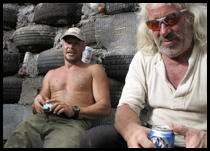
Michael Reynolds – Andaman Islands sustainable housing project



